Homeschooling
The Great Grade Debate: Are Grades Necessary

Grading is one of the most debated parts of education right now.
Recently, Edutopia shared a post about why teachers should grade less frequently and I completely understand the point. Too much grading can create stress for students, burnout for teachers, and honestly, it doesn’t always measure true learning.
That’s exactly why, in my writing academy, I do things a little differently.
Instead of jumping straight into intense grading, I give students choices. And I’ve found that this approach helps students build confidence first… and skills second.
Let me explain.
Feedback Should Support Learning, Not Create Pressure
Most students come into writing classes carrying some kind of anxiety.
They’re worried about being “wrong.”
They’re nervous about making mistakes.
They don’t want their writing picked apart before they even feel comfortable.
And I get it.
Writing is personal. It takes courage.
So my goal isn’t to overwhelm students right away — it’s to help them warm up to the process and feel safe completing the work.
That’s why I focus on feedback more than grades, especially at the beginning.
I Don’t Teach in a Traditional School System
One important thing to know is that I don’t work for a traditional public school.
Most of my students are homeschoolers, or they’re part of hybrid programs where parents have more flexibility in how learning is assessed.
That allows me to create a feedback system that feels supportive instead of stressful.
That said, I also teach students who attend traditional schools.
For those students, they may need a final grade for reporting purposes and I provide that. Usually, I send the final grade directly to the parent so they can submit it to the school.
So, whether a student is homeschooled, hybrid, or traditionally enrolled, they still get the same supportive experience.
Students Can Choose How They Want Their Work Evaluated
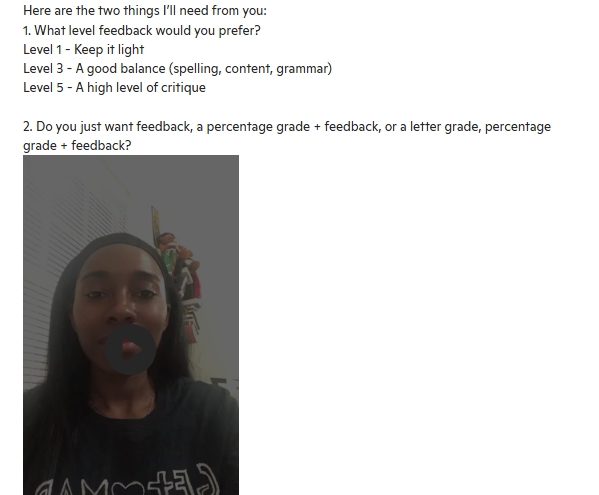
In my classes, students have three options:
-
Just feedback
-
Feedback with a percentage grade
-
Feedback with a percentage and letter grade
This gives families and students control over what feels most helpful for their situation. I have students that ask for level three, but their parents want level five. I meet them in the middle.
Some students thrive without grades.
Others need grades for transcripts or school requirements.
Either way, they get meaningful guidance.
The 1–5 Feedback Intensity Scale
Here’s the part students love the most:
They also choose the intensity of my feedback on a scale from 1 to 5.
This helps students feel empowered instead of pressured.
Level 1: Gentle Feedback
At Level 1, I focus on the basics:
-
Sentence structure
-
Spelling
-
Punctuation
This is perfect for beginners or nervous writers who just need encouragement to get started.
Level 3: Medium Feedback
Level 3 is what I call “suggestion-level feedback.”
Students get helpful notes on:
-
Clarity
-
Organization
-
Grammar patterns
If I mark something as a suggestion, they can fix it, but they’re not required to.
It’s a comfortable middle ground.
Level 5: Full Revision Feedback
Level 5 is for students who want the highest level of growth.
I jokingly tell them:
“I’m going to grade you like I birthed you.”
Because as a parent, my expectations are high and I want them to reach their potential.
Level 5 includes feedback on:
-
Content and depth
-
Structure and organization
-
Grammar and mechanics
-
Word choice
-
Argument strength
-
Full corrections
This is the level students usually choose when preparing for:
-
Dual enrollment
-
College essays
-
Advanced academic writing
-
Serious skill-building goals
Why This System Works So Well
What I’ve noticed over and over again is this:
When students don’t feel pressured in the beginning, they grow faster.
They start with lighter feedback, build trust, gain confidence…
And by the end of the course?
They’re asking for Level 5.
They want the challenge because they feel supported, not judged.
This system helps students:
-
Take ownership of their learning
-
Build confidence as writers
-
Understand feedback as a tool, not a punishment
-
Set goals that match their personal journey
Writing Growth Looks Different for Every Student
Not every learner has the same purpose.
Some students just want to learn how to write clearly.
Others are working toward academic excellence, college applications, or future careers where writing matters deeply.
Giving students choices allows them to meet writing where they are and grow from there.
Feedback Over Fear
I truly believe feedback should feel like coaching, not criticism.
When students have a voice in the process, they become more motivated, more confident, and more willing to improve.
That’s why I don’t believe in one-size-fits-all grading.
I believe in meeting students with support first…
And raising expectations over time.
Want to Learn More About My Writing Classes?
If you’re a homeschool parent, hybrid family, or a student who wants personalized writing support, my academy is built to help students grow at their own pace with feedback that fits their goals.
The classes are also offered on Outschool if you’d prefer single classes.