


One of the things I love about homeschooling is the freedom to let learning begin with a child’s curiosity. Instead of always starting with a textbook or predetermined lesson, you can start with a question, an interest, an experience, or something your child wants to understand better. That is where project-based learning can become such a valuable part of your homeschool.
Project-based learning is an approach where children learn through an extended project that explores a meaningful question, topic, problem, or real-world experience. The project can incorporate multiple subjects, allowing children to practice academic skills while working on something that feels relevant and meaningful to them.
Start With an Interest or Experience
The easiest way to begin project-based learning is to pay attention to what your child is already interested in. What do they ask questions about? What do they spend their free time researching? What do they enjoy building, drawing, collecting, or investigating?
Those interests can become the starting point for your project.
For example, a child who loves animals could research an endangered species, study its habitat, analyze population data, create a habitat model, read nonfiction books, and write a report or presentation. A child who loves cooking could explore fractions and measurement, research the history of a particular food, study the science of baking, calculate recipe costs, and create a cookbook.
You do not have to begin by deciding, “What should we do for history this week?” Instead, start with something your child genuinely wants to know more about and look for the natural academic connections.
Use the World Around You as Your Classroom
Project-based learning also gives homeschooling families a great opportunity to use real-world experiences as the starting point for learning.
A museum visit can become a history project. A nature walk can become a science investigation. A trip can become a geography and cultural studies project. A visit to a local business can lead to a project about economics or entrepreneurship.
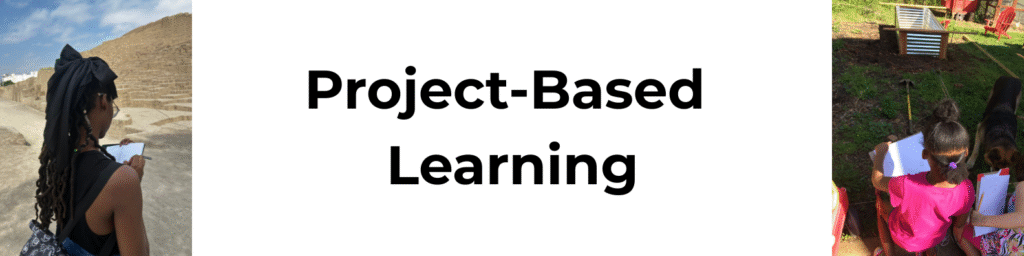
My daughter and I are currently in Peru visiting ancient pyramids and archaeological sites. She has been sketching the ruins she sees, and that simple experience could easily become a much larger learning project.
We could research the civilization that built the site, study the geography of the region, investigate how the structures were constructed, explore the artwork and architecture, sketch what we observe, and write about what we learned.
One experience can connect multiple subjects.
That is one of the things I love most about project-based learning. The subjects don’t have to exist in separate boxes.
Connect Multiple Subjects
A good project can naturally incorporate several areas of learning. Depending on the project, your child might practice:
- History: Research the people, events, or civilizations connected to the topic.
- Geography: Study locations, maps, environments, and cultures.
- Science: Investigate how or why something works.
- Math: Work with measurements, statistics, money, distance, or data.
- Reading: Use books, articles, biographies, and primary sources for research.
- Writing: Take notes, write reflections, create reports, or develop presentations.
- Art: Sketch, paint, photograph, design, build, or create models.
- Public speaking: Present what they discovered to an audience.
The project becomes the common thread connecting the subjects.
Turn Questions Into Lessons
Once your child has a topic or experience to explore, start asking questions.
If your child becomes fascinated by an ancient pyramid, for example, you might ask:
- Who built it?
- When was it built?
- Why was it built?
- How was it constructed?
- What was the environment like?
- What did people eat?
- What did their homes look like?
- What can we learn from the artwork and architecture?
- What happened to the civilization?
Those questions give you a direction for your lessons. From there, your child can use books, documentaries, websites, interviews, photographs, field trips, experiments, and other resources to find answers.
You don’t need to know every answer before you begin. Part of project-based learning is allowing your child to investigate and discover.
Give the Project a Purpose
Projects become even more meaningful when children have something to create or share at the end.
Depending on the topic and your child’s interests, the final product could be:
- A research paper
- A presentation
- A model
- A documentary
- A podcast
- A website
- A piece of artwork
- A map or timeline
- A scrapbook
- A portfolio
- A demonstration
The final product gives your child a reason to organize what they learned and communicate it to someone else.
And it doesn’t have to be elaborate. A project can be as simple as researching a question, creating something, and explaining what they discovered.
You Can Use Project-Based Learning With a Curriculum
Project-based learning does not mean you have to abandon curriculum.
If you already use a curriculum, you can use projects to expand on what your child is studying. If your curriculum introduces ancient civilizations, for example, you could turn that topic into a research and art project. If you’re studying ecosystems, your child could conduct a local ecosystem investigation.
You can also use project-based learning when you don’t follow a traditional curriculum. The resources you choose, the questions you explore, and the projects your child completes can become part of your homeschool plan.
There is no single right way to do it.
Keep It Simple
One of the biggest misconceptions about project-based learning is that every project needs to be elaborate.
It doesn’t.
You do not need expensive supplies, a Pinterest-worthy setup, or a three-month project plan.
Start with one question your child wants to answer.
Find a book. Watch a documentary. Visit somewhere. Conduct an experiment. Interview someone. Make something. Write about it. Share what you learned.
That’s enough.
Project-based learning is not about creating more work for yourself. It is about creating meaningful opportunities for your child to explore, investigate, create, and apply what they are learning.
Start With Curiosity
Homeschooling gives you the flexibility to slow down when your child becomes fascinated by something. You can follow an unexpected question, spend an afternoon at a museum, turn a vacation into a learning experience, or spend a week exploring a topic that wasn’t originally on your lesson plan.
You don’t have to have every lesson planned months in advance.
Sometimes you just need a good question and the willingness to follow it.
Start with curiosity. Follow the questions. Connect the subjects. Create something meaningful.
That is the beauty of project-based learning.